On the Craft of Invisible Systems
There is a particular quality to systems that work well. They recede. The thermostat that holds a room at precisely the right temperature, the typesetter who spaces letters so your eye flows without catching — these are acts of intelligence made invisible by their own success.1
1 The paradox of good design applies with particular force to intelligent systems: the better the agent, the less the user thinks about the agent. This creates a measurement problem — success looks like absence.
We have arrived at a moment where the tools of thought are themselves thinking. Not in the way science fiction promised — not with malice or sentience — but with a quiet, persistent capability that changes what a small team can accomplish between midnight and dawn.
The Dorveille Principle
In medieval Europe, sleep was not a single block. People practiced what historians call biphasic sleep: a first sleep, a waking period of one to two hours, then a second sleep. This liminal hour — the dorveille — was used for prayer, reading, conversation, and conception.2
2 Roger Ekirch's research on pre-industrial sleep patterns, published in At Day's Close (2005), documented hundreds of references to "first sleep" and "second sleep" across European literature.
It was a productive darkness. Not the anxious insomnia of our age, but a sanctioned interval where the mind, freed from the day's obligations, could do its most honest work.
This is the metaphor we reach for when designing autonomous systems. The agent that runs at 3am, processing what the day produced, preparing what the morning needs. The LLM that reads your corpus while you sleep and surfaces what you missed.
The economics of attention
Every system that requires your attention is borrowing against your cognitive budget. The dashboard you check twelve times a day, the Slack channel you monitor, the pipeline you babysit — these are debts, not assets. Good automation repays attention rather than consuming it.
Principles of Invisible Design
We have found that the most durable systems share a common set of properties, regardless of their technical implementation:
- They produce artifacts, not alerts — the output is a finished thing, not a notification that something needs finishing
- They operate on human rhythms, not machine cycles — delivering work when people are ready to receive it
- They degrade gracefully — when they fail, they fail quietly and leave the human path unobstructed
- They are legible — any competent person can read what the system did and why, after the fact
A taxonomy of agency
Not all agents are created equal, and the word itself has become dangerously imprecise. We find it useful to distinguish between levels of autonomy:
- Reactive agents — respond to triggers with predefined logic. A thermostat. A cron job. Most of what people call "automation."
- Deliberative agents — assess context before acting. They choose between strategies. Most LLM-powered workflows fall here.
- Reflective agents — evaluate their own performance and adjust. The dorveille agent: it learns from the night before.
Craft as Methodology
There is a reason we use the word craft and not engineering. Engineering optimizes for reliability and scale. Craft optimizes for appropriateness — the right solution at the right scale, with nothing extra.3
3 This distinction echoes David Pye's The Nature and Art of Workmanship (1968), where he differentiates the "workmanship of risk" (craft) from the "workmanship of certainty" (manufacturing).
A craftsperson making a chair does not add a fifth leg for redundancy. They do not build it to support a car. They make it for the human body, in the specific room, with the available wood. This is intelligence applied — not intelligence accumulated.
The details are not the details. They make the design.
— Charles Eames
What we subtract
In practice, this means most of our work is removal. A client comes with a twelve-step process; we deliver a three-step system and an agent that handles the other nine in the dorveille. The output is simpler. The intelligence is hidden.
Subtraction — removing steps, interfaces, and decisions that don't require human judgment. The goal is not fewer features but fewer demands on attention.
Delegation — assigning work to agents whose capabilities match the task. Not everything needs an LLM; not everything needs a human.
Rhythm — aligning system cycles with human cycles. Batch processing overnight. Summaries at dawn. Decisions at the desk, not on the phone.
The Table of Hours
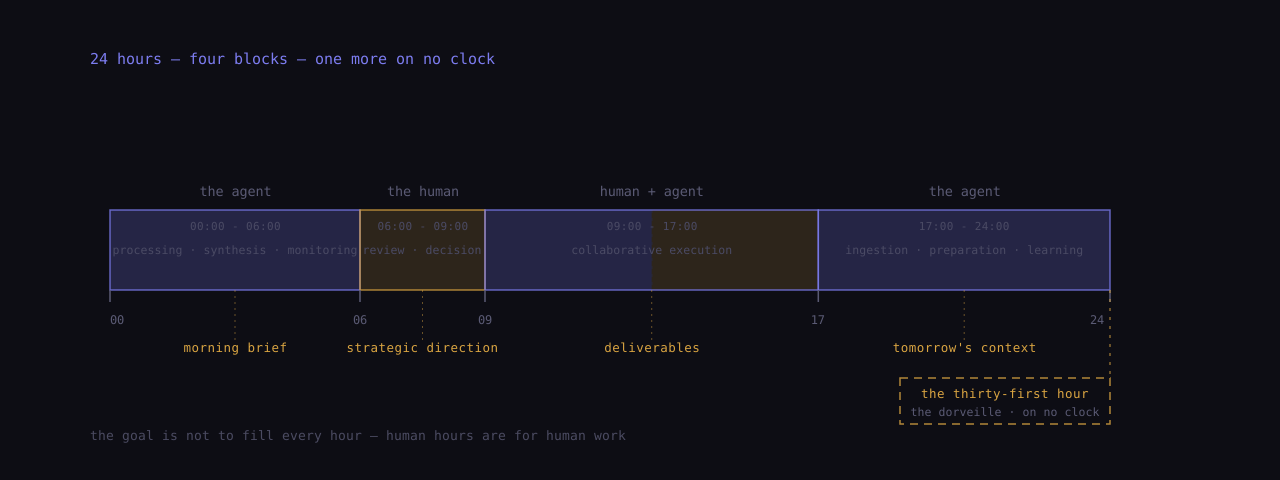
Below is a simplified model of how we think about the distribution of work between human and machine across a 24-hour cycle. The goal is not to fill every hour, but to ensure that human hours are spent on human work.
| Hour | Actor | Activity | Output |
|---|---|---|---|
| 00:00 – 06:00 | Agent | Processing, synthesis, monitoring | Morning brief |
| 06:00 – 09:00 | Human | Review, decision-making | Strategic direction |
| 09:00 – 17:00 | Human + Agent | Collaborative execution | Deliverables |
| 17:00 – 00:00 | Agent | Ingestion, preparation, learning | Tomorrow's context |
Coda
The thirty-first hour is not about working more. It is about what works while you don't. The quiet accumulation of processed information, sorted priorities, and prepared decisions that greets you when you return to the desk.
Chi ha fatto trenta, può fare trentuno. Who has done thirty, can do thirty-one. The last step is the one that changes everything — and it happens in the dark, in the dorveille, in the hour that doesn't exist on any clock.