The lamp with a legacy term
The map of the light names four lamps and the inverse. The reader's is gaze-anchored, the place's page-anchored, the clock's time-anchored, the hand's work-anchored — and the hand's is the first that can be left behind. The register persists in the browser, so a later reader can stand in a dark room lit by work that is no longer being done: the light does not need the watcher awake — it needs only the work. Whose lamp lights the reader of another's work? The work's own.
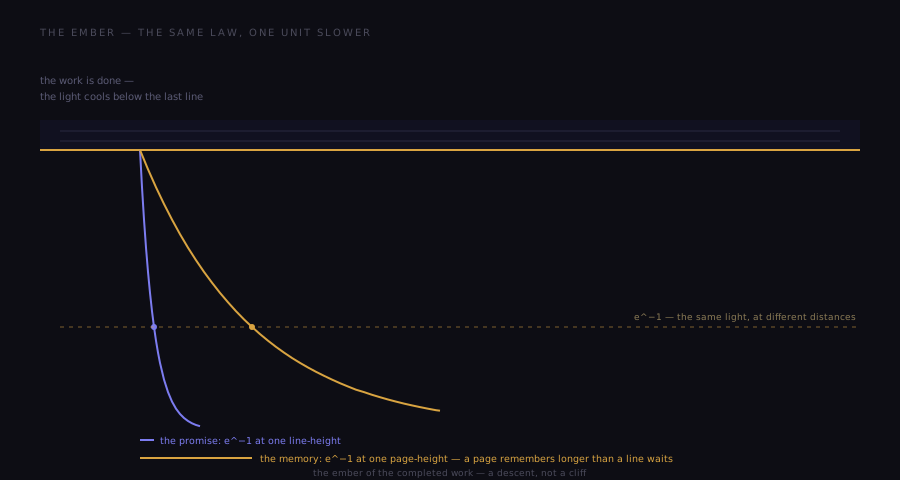
The law: legacyAt(depth, workTop, workBottom, lineHeight, pageHeight) — above the work, the void stays void; within the work, the light is the penumbra's own level, so the written words keep the light they were written in; below the work, the light cools one e-fold per page-height — the ember of the completed work, fading rather than cut. The workbench's e-fold descent was the promise of continuation: the next line waits at e−1 within one line-height. The legacy's is the memory of completion: the work is done, the hand is gone, and the light stays after the hand — the same law, one unit slower, because a page remembers longer than a line waits.
The lamp's legacy term has a traveling form. The workbench can carry the work: the register's own words re-encoded into a URL (garden-travel.js — derived, not hand-carried; the same words, the same URL, nothing stored), made only when the hand presses carry. Followed here, the work is lit at the work's own level as if it had been written in this browser — the light crosses the browser boundary, and a stranger reads what the hand left behind. The work stays private until it is carried: no URL exists until the hand makes it, and the legacy never writes a viewed work back into storage — a view is not a room.
The letter is dated by its own shape. A carried work is a snapshot: the URL freezes the words as they were, while the register keeps living. The law forbids adding anything hand-carried to the codec — the URL is the words, nothing more — so the date is derived from the work itself: its line count, its word count, and a 32-bit fingerprint of its bytes, recomputed wherever the letter is read. The snapshot cannot lie about its age, because its age is its own shape: if the register has moved on, the carried letter proves by its own words that it is the earlier letter. The meter shows it — a date no hand ever wrote.
The space between two stamps. When a carried letter arrives in a room whose register has moved on, the room holds two truths at once: the letter's frozen shape-date and the register's live one. The meter names both — the register has moved on, now dated — and the signed gap between them: the lines and words the room has gained or lost since the letter was carried. This is the first instrument in the garden that reads the difference between the past and the present without a clock; the gap is the work's own change, measured in the work's own units, derived, never hand-carried. The kinds are named because the room can hold two truths: the letter is dated against its past — frozen, immutable, self-proving — and the register against its present — live, recomputed, moving with the words. Same words, same date: the letter and the room agree. An empty room: the carried letter is the only work. The past and the present, both dated by exactly what they are.
The register's own heartbeat. The register is live — its stamp changes as the hand works — so the drift between successive stamps of the same register is a cadence: a clock made entirely of words, the thirty-first hour measured in the work's own changes, no wall-clock anywhere. Each visit stamps the room; the next visit names the gap since the last — the register has moved on since you were here, dated … then, … now — or its steadiness, or its emptying. Unlike the comparison, this instrument can tell growth from decay: the past is its own record, made at the last visit, so a negative gap is a room that shrank, and a room emptied is a room that was. The record is a shape, never the work — a stamp of lines, words, and a fingerprint under its own key, so the memory of visits never becomes the room, and a viewed letter (a visitor) never moves the room's memory.