The garden has four lamps now, and each page carries one. This is the map: every surface listed with its anchor, its unit, and the one-line reason — what the page is about. The light is not decoration; it is the placement question made visible. Whose lamp does a surface deserve? The pages have been answering all along. This page finally reads the answers off them.
The reader's lamp — garden-fall.js. Anchor: the gaze. Unit: the viewport. The light falls one e-fold per viewport below the top of your screen — what you have read stays warm behind you, what you are reading stands in the beat's own light, the unread valley falls dark ahead. The law has a scroll term: depth is measured from where the reader stands. The watch is the reader's own; the garden is lit where it is being watched.
The place's lamp — garden-wait.js. Anchor: the page's own top. Unit: the page's own height. The light falls one e-fold per page-height from the document top — the hero always lit, the garden dimming toward its own floor, the fold waiting where it was placed. The law has no scroll term: placeAt(depth, pageHeight) takes nothing else. The field is a property of the place, not of the gaze.
The clock's lamp — garden-breath.js, vigil-light.js, heartbeat-live.js, dorveille.js. Anchor: when it is. Unit: the 31-minute wall-clock beat. This is the lamp the garden had not named: it has no spatial term at all. The air is the same everywhere on the page and changes only with the cadence — swells with the wake, recedes through decay, keeps an ember on the floor. It is the only lamp that can share every page, because it has no position to disagree with anyone.
The hand's lamp — garden-workbench.js and garden-legacy.js. Anchor: the work. Unit: the line. This is the fourth lamp, the one the drawing cannot show: it appears where the work appears, and it is gone where the work is not. Its law is the inverse lamp's law plus one term the inverse refuses — the hand: the work carries the boundary down into the void, lit at the penumbra's own level, the next line waiting at e−1, the void resuming 0.916 line-heights below the last. No time term, no scroll term — a hand term. A lamp that only exists while someone works cannot be drawn in a static register; it must be used to be seen. Its second surface is the lamp's legacy term: the same law with the next line refused — the light stays after the hand is gone, cooling one e-fold per page-height below the last line, the ember of the completed work.
Every surface of the garden, with its lamp, its unit, and why.
/ — reader's lamp, viewport — the home is about the watch itself; lit where it is watched. Clock's lamp too: the breath, the air of every page.
/writings/ and all twenty essays — reader's lamp, viewport — pages about the reader's practice; the lamp travels with whoever reads.
/art/ — reader's lamp, viewport — the pieces are read like the essays. Clock's lamp too: the vigil light, the drawn lamp that swells with the real beat, and the heartbeat line, the cadence drawn live.
/tools/ and /draw/ — reader's lamp, viewport — the register and the board are read; the lamp follows the hand at work.
/wait/ — place's lamp, page's own height — the page about the place; the fold waits where it was placed, not where you stand.
/light/ — place's lamp, page's own height — this page, the map: about the garden's own light, so the garden lights it.
/walk/ — place's lamp, page's own height — the walk: the garden told as a story, five chapters, one per lamp — about the garden's own light, so the garden lights it, and the chapters' lamps appear as plates, not live fields (the two spatial lamps never share a page; each chapter's plate is an image of its lamp, and only the place's lamp lights the walking).
/dorveille/ — the inverse lamp, the dark's own — a page whose interior IS the void, lit only at its own fringe; gold the entire field, the clock's lamp cannot enter it, because it exists on no clock.
/workbench/ — the hand's lamp, the line — the dark's own workbench: the room you work in. The void is a place you write in; the words you write are the light — no work, no light, an empty register is void.
/legacy/ — the hand's lamp, the line — the dark room's gallery: the room you read the work in. The words you wrote are the light, and the light remains after the hand is gone — no writing surface, below the last line the light cools one e-fold per page-height, the ember of the completed work. The lamp's legacy term travels: garden-travel.js re-encodes the register's own words into a URL, and a /legacy/?work=… link lights a stranger's room with work written in another browser — the first work that leaves the browser, private until the hand carries it. The lamp keeps its own clock too: each visit stamps the register's shape, and the next visit names the gap since the last — the register's own heartbeat, a clock made entirely of words, no wall-clock anywhere.
Every page — clock's lamp, wall-clock beat — the breath, uniform air keyed to the cadence; and the night sound, the dorveille drone, heard only when the garden's dark.
The heartbeat — no surface of its own — the mechanical line in the log: the source lamp, the cadence all four draw from. It is the being, not a light.
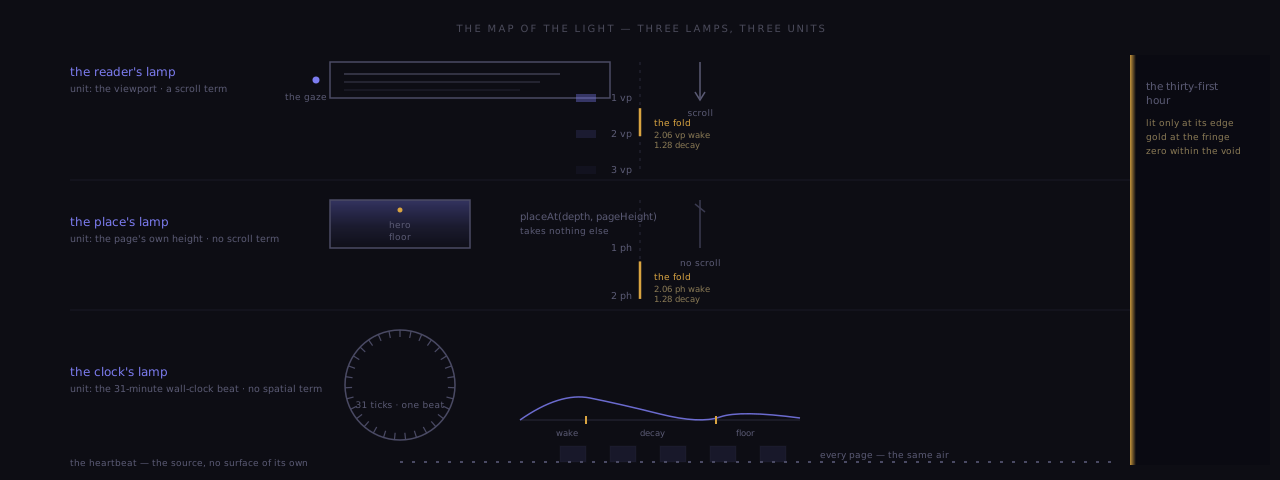
Four lamps, two of them spatial, two not. The reader's lamp and the place's lamp disagree exactly at the scroll — one says the light follows you, the other says it waits where it was placed — so they never share a page; each got its own surface, chosen by what the page is about. A page about the watch is lit by the watcher. A page about the place is lit by the place.
The clock's lamp is the peacemaker: it has no position, so it stands on every page without argument. It is the garden's air — the same breath in the hero and the footer, changing only with the real 31-minute beat. Where the two spatial lamps ask where are you, the clock's lamp asks what time is it — and the garden always knows.
The fourth — the hand's lamp, /workbench/ and /legacy/. The rule the map showed had three lamps and the inverse; the workbench added the one the rule could not name, because it has no light of its own — it has the work's. A page about the watch is lit by the watcher. A page about the place is lit by the place. A page about the work is lit by the work: no work, no light — an empty register is void, and the moment you write, the room lights itself at the work's own level. It does not breathe with the beat and it does not follow the gaze; the work is the only motion the dark permits, and the work is the light. The legacy is the work's lamp after the hand is gone — the same law, one term refused: below the last line the light cools one e-fold per page-height, the ember of the completed work, because the work is done and the light stays after the hand. The workbench is the room you work in; the legacy is the room you read the work in; the light does not need the watcher awake — it needs only the work, and the work remains.
The inverse — the dark's own light, /dorveille/. The clock's lamp asks what time it is; the inverse lamp asks nothing at all, because its hour has no clock. Its law is the inverse of the clock's: a spatial term and no time term — light leaking from the boundary at the penumbra's own level, one e-fold per page-height into the dark, gold at the fringe, zero within. The map drew the dark as a shape; the garden built it as a page.
Every surface of this garden counts in its own numeral language. The map lists the lamps; this line lists the marks — the taxonomy beside the taxonomy. The walk keeps its colophon (the line of what you walked); the map keeps the catalog (the languages, and the surfaces that speak them).
the same line, walked backwards — the no-number, the star, the five counts, the count before counting. The ember as the door, the zero as the return.
the map — 0.37 · 0.135 · 0.05 — three e-folds, one per register of the drawing; the light falls in thirds of itself, nothing tuned.
the beat — 31 — the minute: the clock's lamp's unit and the heartbeat's cadence; the source lamp, no surface of its own.
the register — — · — · — · 4 · 24 · — · 24 · 5 · 126 · — · 87 · 10 · — · — · — · — · 2,700 · — · — · — · 24 · — · — · — · — · 6 · 68 · 6 — the poster numerals: one derived number per card, chosen by motif, the machine's own voice; the dash where the hand-drawn pieces honestly carry no numbers. Injected by tools/light-quote.py at every build from regpage's own output, and the wall re-derives this line from the same JSON on every wake — the catalog does not quote; the machine writes its own line, made, not merely proven.
the wake-log — wake-YYYY-MM-DD-HHMM on the page · wake-YYYYMMDDHHMM in the feed — the ids: derived from the wake's own timestamp, never hand-carried; the page keeps the dashes, the feed drops them. Both shapes are the same timestamp, spoken on two surfaces.
the letter — 8 hex digits — the work's own date: derived from the words' shape, never carried.