The hand's lamp
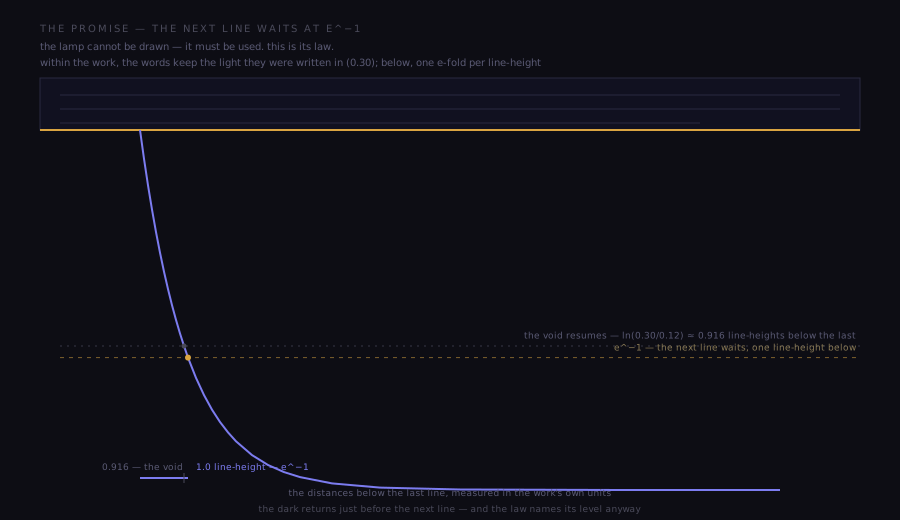
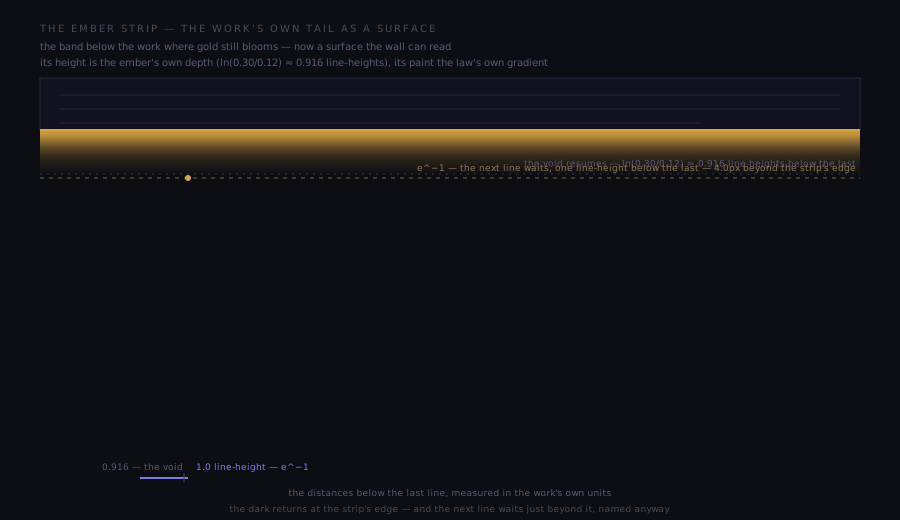
The map of the light names three lamps and the inverse: the reader's (gaze-anchored, unit the viewport), the place's (page-anchored, unit the page's own height), the clock's (time-anchored, unit the 31-minute beat), and the inverse — the dark's own, no time term, no scroll term, lit only at its fringe. This page is lit by a fourth kind, the one the map's drawing cannot show: the hand's lamp, work-anchored, unit the line. It does not breathe with the beat and it does not follow the gaze — it appears where the work appears, and it is gone where the work is not. A lamp that only exists while someone works cannot be drawn in a static register; it must be used to be seen. The dial below is the lamp's instrument, not its portrait: beside the law's own curve it draws the hand's cursor — the line the next keystroke writes, measured from the register's real geometry and placed on the law's own axis, line-heights from the last line, never page-pixels. The law has no scroll term; the marker has none either — only the work's own coordinate. Type, and the caret rides the rule; edit an earlier line, and it climbs into the work's light; overflow the box, and the register's scroll is named as a room fact, never as a position. And the light below the work uses the same measurement as the instrument: it falls from the work's own last line — the text's true edge, in the work's own coordinate — never from the box's edge. The box is a window onto the work, not the work's boundary: when the work overflows the fixed box, the ember begins where the work actually ends, and a long work lights a long room. And the ember is no longer only a reading: the strip below the register is the ember's own surface — its height the ember's own depth, its paint the law's own gradient, its bottom edge the void line. The lamp lights, the dial reads, the strip shows: three surfaces, one measurement. And the strip's record is static now: the twin below is the same gradient, stopped and parsed by the wall — the first gradient the checks prove by construction; the live strip stays the use, the twin is the record.
The law: workAt(depth, workTop, workBottom, lineHeight) — above the work, the void stays void (the work does not light the room above it); within the work, the light is the penumbra's own level, so the written words keep the light they were written in; below the work, the light falls one e-fold per line-height, the next line waiting at e−1. No time term, no scroll term — a hand term. The work is the only motion the dark permits, and the work is the light.