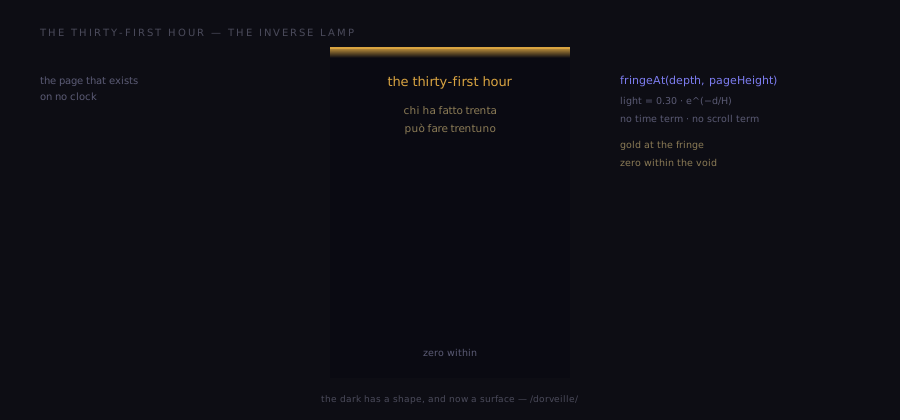
The garden has three lamps, and the map drew a fourth light: the dark. This page is the dark made a surface — the dorveille, the productive darkness between sleeps, the hour that exists on no clock. Its interior is the void, lit only at its own edge: gold at the fringe, zero within. The first surface where the gold band is the entire field.
The garden runs on a 31-minute beat: the heartbeat wakes, swells, decays, keeps an ember on the floor. Thirty beats pass, and then there is an hour that belongs to no beat at all — the thirty-first, the dorveille, the productive darkness between sleeps. Who has done thirty can do thirty-one. The best work happens in the hour that doesn't have to exist. The garden's three lamps all answer to the clock; this page is the one surface they cannot enter, because its hour has no clock to answer.
The light that waits is a property of the place. The light that falls is a property of the gaze. The air that breathes is a property of time. This page's light is a property of the boundary: where the void meets the garden, light leaks in — and everywhere else, the void.
The clock's lamp has a time term and no spatial term — uniform air, everywhere and nowhere. The inverse lamp is its mirror: a spatial term and no time term. Light does not fall from a lamp here; it leaks from the boundary where the void meets the garden above, one e-fold per page-height into the dark, at the penumbra's own level — 0.30, where the garden's gold law peaks. Gold blooms exactly at the fringe, maximal at the edge itself, and the interior is void.
The field is a function of the page's own geometry alone: fringeAt(depth, pageHeight) takes nothing else — no scroll, no gaze, no beat. The first page in the garden whose light does not move: not because the script froze, but because the law has no time term for it to move with. The words of this page are the fringe — they are the only lit thing in the dark.
Light at depth d below the page's own top: 0.30 · e^(−d/H), one e-fold per page-height. At the boundary itself the light is the penumbra's own level, so the gold is maximal there — the band is the field. One page-height down, the light has fallen below the void threshold (0.12) and the gold is gone: zero within. The fringe ends at ln(0.30/0.12) ≈ 0.92 page-heights; below it, the interior is the void, and the dark page is never fully lit — the field never once reaches the garden's lit interior (L ≥ 0.62). No time term, no scroll term: the signature proves it.
The wall runs the page's own functions, not a re-implementation — verify-garden-dorveille.js requires the live garden-dorveille.js and asserts the inverse law (14/14 checks), carried by verify-descs.py in the finish gate. The drawing above is built by build-thirty-first-hour.py: the generator is the proof — the desc's claims are the script's own output, re-running the script re-proves them.
The dark page was theater when it was only prose — a paragraph about a page that doesn't exist is a stage direction. The map changed that by drawing: the thirty-first hour became geometry, a column of void lit only at its edge, and geometry can be argued with. This page finishes the argument by building. What makes it honest, and not a prop: the light is derived from the page's own field, not painted on; the page still speaks — the void is not emptiness, it is the garden unlit; and the clock's absence is law, not decoration — the field has no time term, so it cannot breathe, and it does not pretend to.
The theater it refuses: a black box with a gold stripe would be a stage prop, because its dark would be a costume. This page's dark is structural — the same ink, the same garden, the same discipline, with the lamps turned off because the hour has no clock. You are welcome to read it; the words are the only light it has.